


CAIRO – The Middle East has been a hotbed of conflict for decades, so many countries in the region have built up their artillery stockpiles. This indicates that they are among the world’s most war-ready nations in 2025.
Many also opt for the latest technology, using MLRS (Multiple Launch Rocket Systems). In fact, this weaponry buildup in several Middle Eastern countries rivals that of some European countries and, in some cases, far exceeds it. 24/7 Wall St. took a closer look at the Middle Eastern countries with the largest MLRS unit inventories.
To identify the Middle Eastern countries with the most MLRS units, 24/7 Wall St. reviewed the 2024 Military Power Rankings from Global Firepower, a defense-related statistics website updated annually with information on 145 countries.
Understanding military dynamics in the Middle East is crucial given the region’s historical and ongoing geopolitical tensions. For decades, the Middle East has been shaped by conflict, religious divisions, and territorial disputes, making it a hotspot for conflict. Whether it’s Iran’s growing influence or the strategic role of countries like Saudi Arabia and Israel, military power in the region significantly impacts global security and energy markets.
7 Middle Eastern Countries Most Prepared for War in 2025.
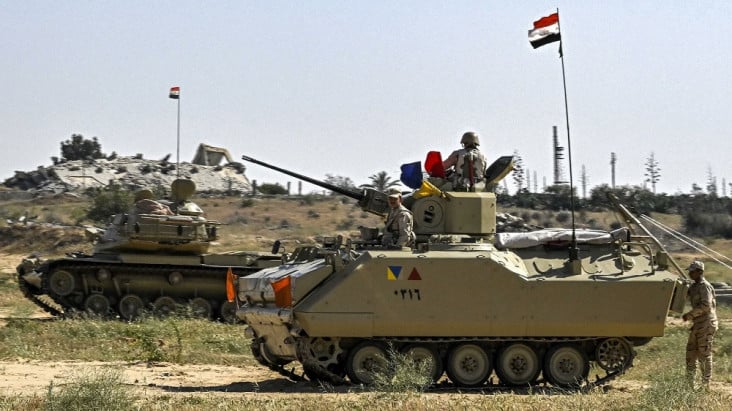
1. Egypt
Number of Multiple Launch Rocket Systems (MLRS): 1,119
Number of tanks: 5,340 Number of artillery pieces: 3,046
Number of military vehicles: 77,596
Military power score and world ranking: 0.2283 – #15 of 145
In addition to ground forces, Egypt has 1,080 military aircraft (including 88 attack aircraft, 238 fighter jets, and 338 helicopters). Egypt has 440,000 active personnel out of a total population of 109.5 million. Located between the Middle East and Africa, Egypt controls one of the world’s most important shipping lanes, the Suez Canal.
This crossing has historically helped Egypt rise to become a leading military power. From the time of the Pharaohs thousands of years ago to the present, Egypt has been a formidable military force. More than a decade ago, the Egyptian military played a key role in the Arab Spring, particularly in the overthrow of President Hosni Mubarak in 2011 and President Mohamed Morsi in 2013.
2. Iran
Total Multiple Launch Rocket Systems (MLRS): 775
Number of tanks: 1,996 Number of artillery pieces: 2,630
Number of military vehicles: 65,765
Military power score and world ranking: 0.2269 – #14 of 145
In addition to the ground forces, Iran has 551 military aircraft (including 23 attack aircraft, 186 fighter jets, and 129 helicopters). Iran has 610,000 active personnel out of a total population of 87.6 million.
Iran is another country that traces its military history back to the time of the Persian Empire. The country boasts a rich history in this regard. However, many Western powers currently view Iran as a regional antagonist, which has led to sanctions against the country, hampering military modernization. Iran’s nuclear program has raised international concerns about its potential nuclear weapons capability.
3. Syria
Total Multiple Launch Rocket Systems (MLRS): 614
Total tanks: 2,720 Total artillery: 2,695
Total military vehicles: 14,550
Military power score and world ranking: 1.0026 – #60 of 145
In addition to ground forces, Syria has 452 military aircraft (including 57 attack aircraft, 168 fighter jets, and 153 helicopters). Syria has 170,000 active personnel out of a total population of 22.9 million.
Syria’s military history is marked by its strategic location, which has made it a focal point in regional and international conflicts. Historically, Syria has been part of major empires due to its position between the Mediterranean and the Arab world. The country gained independence from France in 1946 and has since been involved in several wars with Israel and the Lebanese Civil War.
The latest chapter in Syria’s military history began in 2011 with the Syrian Civil War, sparked by the Arab Spring protests. This war was fiercely fought by various factions, including ISIS, Kurdish forces, and foreign military powers such as Russia, the US, Turkey, and others. As of 2024–2025, Syria remains divided; while the main front lines are frozen, conflict continues in several regions (Idlib, Daraa, and the northeast).
4. Saudi Arabia
Total Multiple Launch Rocket Systems (MLRS): 490
Total tanks: 1,485
Total artillery: 3,253
Total military vehicles: 20,694
Military power score and world ranking: 0.3235 – #23 of 145
In addition to ground forces, Saudi Arabia possesses 914 military aircraft (including 81 attack aircraft, 283 fighter jets, and 262 helicopters). Saudi Arabia has 257,000 active personnel out of a total population of 36 million. Saudi Arabia has a rich military history that spans centuries. The modern state as we know it today was founded in 1932, decades after Abdulaziz Al Saud (Ibn Saud) unified the Saudi state after conquering Riyadh in 1902.
The discovery of oil in the 1930s catapulted the Kingdom to a prominent position on the world stage. Through this oil trade, Saudi Arabia has gained significant advantages over its many Western trading partners, such as the United States.
In addition to the oil trade, Saudi Arabia has also acquired advanced weaponry and aircraft from these Western countries, making it one of the most dominant military powers in the region. Saudi Arabia also played a key role in the Gulf War as part of the coalition that expelled Iraqi forces from Kuwait.
5. Turkey
Total Multiple Launch Rocket Systems (MLRS): 286
Total tanks: 2,231
Total artillery: 2,785
Total military vehicles: 55,104
Military power score and world ranking: 0.1697 – #8 of 145
In addition to ground forces, Turkey has 1,069 military aircraft (including 205 fighter jets and 502 helicopters). Turkey has 355,200 active personnel out of a total population of 83.6 million. Turkey’s military history is deeply rooted in its role as a center of power during the Ottoman Empire. Furthermore, its strategic location, connecting Europe and Asia, is crucial to its military history and the composition of its forces. Turkey’s membership in NATO is largely due to this fact.
The dissolution of the Ottoman Empire after World War I and the subsequent Turkish War of Independence were significant events that not only established the new nation’s borders but also created a strong military tradition that continues to influence Turkey to this day.
6. United Arab Emirates
Total Multiple Launch Rocket Systems (MLRS): 162
Total tanks: 354
Total artillery: 282
Total military vehicles: 12,253
Military power score and world ranking: 0.8083 – #51 of 145
In addition to ground forces, the United Arab Emirates has 560 military aircraft (including 18 attack aircraft, 99 fighter jets, and 246 helicopters). The UAE has 65,000 active personnel out of a total population of 10 million.
The United Arab Emirates has a relatively short but highly dynamic military history. The country was formed in 1971 when seven emirates merged, focusing on building a strong military focused on advanced technology and modernization. The US and France are major suppliers of this technology to the UAE, and in return, the UAE has been involved in regional operations in the Gulf War, Yemen, and against ISIS
The UAE’s power extends far beyond its relatively small territory in the Persian Gulf. In fact, the country has projected power abroad, establishing military bases in the Horn of Africa and beyond.
7. Israel
Total Multiple Launch Rocket Systems (MLRS): 150
Total tanks: 1,370
Total artillery: 950
Total military vehicles: 43,407
Military power score and world ranking: 0.2596 – #17 of 145
In addition to the ground forces, Israel has 612 military aircraft (including 39 attack aircraft, 241 fighter jets, and 146 helicopters). Israel has 170,000 active personnel out of a total population of 9 million.
Israel’s military history is closely tied to its national identity. The country has compulsory military service for its citizens (especially Jews). Israel was founded in 1948 and immediately engaged in conflict with neighboring Arab states in an attempt to prevent its formation. In the coming decades, and even now, Israel will be at the center of conflict in the region.
Other significant conflicts that Israel has successfully resolved, and even expanded its territory in some cases, include the Suez Crisis, the Six-Day War, the Yom Kippur War, and other conflicts with Lebanon. Its recent engagement with Hamas has devastated the Gaza Strip, and the international community is deeply concerned about the ongoing situation.